Bull, bear & sideways chop regime detection explained: 2-state vs 3-state vs factorial HMMs
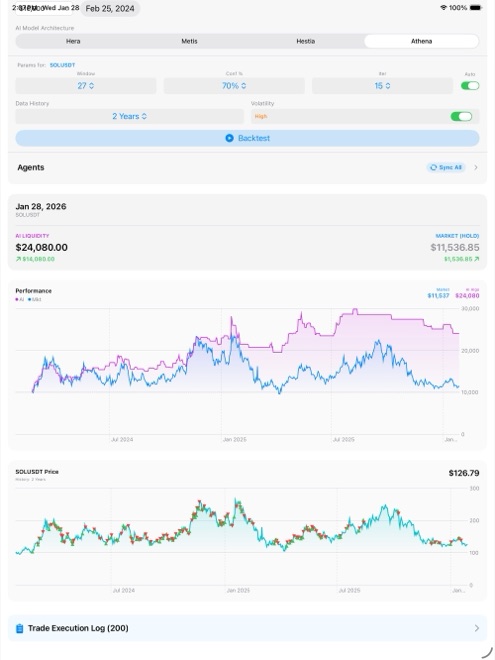
Binary “bull or bear” labels fail in crypto because markets spend months grinding sideways in noisy consolidation where both trend-following and panic-shorting lose ground. Market Brief AI ships four Hidden Markov Models on iPhone and iPad—Hera (3-state), Metis (input-aware), Hestia (duration-aware), and Athena (factorial)—to separate bull, chop, and bear states on public Binance USDT history and backtest strategies against buy-and-hold for educational simulation, not financial advice.
1. Why crypto requires at least three regimes: calm bull, noisy chop, volatile bear
Forcing every candle into a binary bull/bear split miscategorises horizontal consolidation—causing constant long/flat churn whenever daily returns hover near zero with moderate variance. Adding a third transitional or chop state gives directionless bars their own statistical bucket so a simulated strategy can adopt a disciplined WAIT posture until confidence clears your chosen threshold.
Across crypto cycles back to 2017 on Binance USDT spot pairs, bull states typically exhibit positive mean drift with controlled variance, chop states show near-zero drift with whippy noise, and bear states combine negative drift with sharp volatility expansion.
| Latent state | Typical return drift (mu) | Typical volatility (sigma) | Simulated posture implication in Market Brief AI |
|---|---|---|---|
| Bull / calm uptrend | Positive bar-to-bar drift | Low to moderate variance | High bull likelihood supports simulated BUY posture above confidence threshold |
| Chop / sideways transition | Near-zero or mixed drift | Moderate range-bound noise | Split probabilities keep simulated strategy in neutral WAIT posture |
| Bear / high-variance decline | Negative drift & liquidation tails | Elevated / expanding variance | High bear likelihood triggers simulated SELL / flat posture (+ Pro guards) |
2. Comparing Hera, Metis, Hestia, and Athena inside Market Brief AI
Once you understand 3-state separation, three deeper statistical questions arise: What if US CPI or news sentiment shifts transition odds? What if a regime becomes more or less sticky the longer it lasts? What if macro and short-term volatility layers move semi-independently?
Market Brief AI answers each question with a dedicated model computed locally on iOS 26 and iPadOS 26—from free baseline Hera up to Pro’s multi-layer factorial Athena.
| Model | Tier | Statistical architecture | Best educational research question |
|---|---|---|---|
| Hera | Free ($0) | Classic 3-state Hidden Markov Model on price returns | How clearly do returns alone separate bull, chop & bear states? |
| Metis | Plus ($7.99/mo) | Input-aware HMM reading external context series alongside returns | Do GDELT FinBERT sentiment & macro agents sharpen state transitions? |
| Hestia | Plus ($7.99/mo) | Duration-aware HMM modeling how long each regime tends to persist | Does explicit state-duration memory curb 1–2 bar false switches? |
| Athena | Pro ($12.99/mo) | Factorial HMM tracking multiple hidden regime layers at once | How do layered volatility & structural regimes interact with auction/guard rules? |
3. Validating trend vs mean-reversion overlays across regimes
Breakout indicators (like SuperTrend or auction imbalance breakouts) thrive in directional regimes, whereas rotational tools (like POC reversion or seasonality blends) behave very differently in range-bound states. Market Brief AI Pro lets you toggle fractal pivots, seasonality, SuperTrend, flags, five auction signals, and four crash/drift guards on top of your chosen HMM.
Every test replays closed-bar decisions from $100 to $1B virtual capital directly over passive buy-and-hold, with full local trade logs so you can verify results honestly rather than guessing.
| Step | Action in Market Brief AI | Overfitting check |
|---|---|---|
| 1. Baseline fit | Run free Hera on BTCUSDT or ETHUSDT daily history from 2018 or 2021 | Inspect whether purple equity only won on one single exit bar |
| 2. Confidence sweep | Raise and lower confidence threshold (or compare with auto-tune) | Check trade marker frequency during 2019 or 2023 sideways stretches |
| 3. Model progression | Compare Hera vs Metis, Hestia & Athena on identical start dates | Verify extra complexity actually improved out-of-window consistency |
| 4. Log audit (Pro) | Open the full trade execution log and read firing rules | Confirm crash guards (CUSUM/EMA) fired sensibly without excessive churn |
Why does Market Brief AI include WAIT alongside BUY and SELL in backtests?
Because sitting out ambiguous sideways chop or bear drawdowns in simulated cash is central to testing whether regime detection adds value over continuous passive holding.
Can auto-tune choose the window, confidence, and iterations for me?
Yes. You can manually set the window, confidence, and iteration budget for any of the four HMMs or let auto-tune pick.
Do Metis, Hestia, and Athena run in the cloud?
No. Every model—from Hera to Athena—computes locally on your iPhone or iPad with zero cloud AI.
Does regime detection predict black-swan crashes in advance?
No. Statistical models learn from historical and public data and cannot foresee sudden shocks; nothing in Market Brief AI is financial advice or guarantees real-world performance.