Hidden Markov Models for Crypto Regimes Explained
Price charts show every candle clearly, yet the underlying market environment—steady trend, noisy sideways chop, or high-volatility selloff—cannot be observed directly. A hidden Markov model (HMM) treats those regimes as unobserved statistical states and estimates their bar-by-bar probabilities from historical returns. Market Brief AI fits these models locally on iPhone and iPad for educational simulation, not financial advice.
Observed returns versus hidden market states
In everyday technical analysis, traders draw moving averages and call anything above the line a bull market. The catch is that a moving average reacts with fixed lag regardless of whether volatility just tripled. A hidden Markov model approaches the series probabilistically: you observe bar-to-bar returns, while an underlying latent state generates those returns with its own mean drift (written in Latin notation as mu) and volatility dispersion (sigma).
In Market Brief AI’s free baseline model, Hera, the series is modelled across three classic states: a calmer positive-drift uptrend (bull), a noisy sideways or transitional regime (chop), and a negative-drift high-variance decline (bear). Instead of a binary label, every bar receives a probability distribution summing to 100 percent across the states.
- Emission distribution: describes what return mean (mu) and standard deviation (sigma) look like inside each hidden regime.
- Transition matrix: estimates the probability of staying in the current state versus switching to another state on the next bar.
- Initial state distribution (pi): sets starting state probabilities at the opening of the training window.
How Hera fits public Binance USDT history on your device
Market Brief AI downloads public spot price bars quoted in USDT from Binance—daily candles back to 2017, plus recent hourly and five-minute intervals—and computes the Baum-Welch / expectation-maximisation updates directly on your iPhone or iPad. No cloud AI server receives your settings, and there is no brokerage connection or live order execution anywhere in the app.
You control three core hyperparameters when fitting a regime model, or you can let auto-tune select a balanced configuration for the chosen asset.
- Select any Binance USDT spot pair in Market Brief AI and sync its daily, hourly, or five-minute price history.
- Choose the Hera three-state model and inspect the lookback window, confidence threshold, and iteration budget.
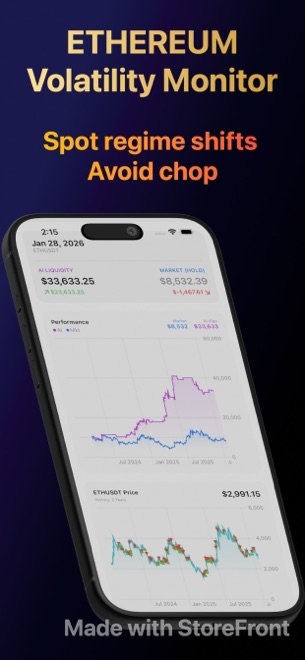
- Run the local fit and examine how the price chart colours historical bars by bull and bear regime probabilities.
- Open the closed-bar backtest directly beneath the chart to test whether acting on those probabilities would have differed from passive buy-and-hold.
Why confidence thresholds matter during sideways chop
Crypto markets spend long stretches whipsawing inside horizontal ranges where bull probability hovers near 0.45 and bear probability sits near 0.40. Treating a slight 0.48 plurality as a high-conviction directional call triggers constant simulated turnover during flat weeks.
Raising the model’s confidence parameter forces the simulated strategy to require stronger state separation before leaving a neutral WAIT posture. Comparing low-confidence and high-confidence runs on the same historical window quickly illustrates the trade-off between early trend entry and false-switch whipsaws.
What an HMM regime probability cannot tell you
Because a hidden Markov model learns transition and volatility patterns strictly from historical bars, it has zero foresight into sudden exchange outages, protocol exploits, or unprecedented regulatory shocks until returns start reflecting the move. Past regime persistence never guarantees future performance.
Treat state probabilities as a disciplined diagnostic lens for historical research rather than a crystal ball. Always review the disclaimer card and compare every simulated curve against simple holding before trusting a parameter tweak.
Does Market Brief AI execute crypto trades or give financial advice?
No. Market Brief AI is strictly an educational market-analysis and strategy-simulation tool with no brokerage or wallet integration. Nothing shown is a recommendation to buy, sell, or hold any asset.
Why use three states instead of just bull and bear?
A two-state model forces low-conviction sideways consolidation into either the bull or bear bucket. Including a third chop/transitional state gives noisy range-bound bars their own statistical home.
Is the Hera three-state HMM available in the free version?
Yes. Fitting Hera on any Binance USDT pair, viewing regime probability charts, and running closed-bar backtests against buy-and-hold are completely free with no account and no ads.