3-State, Input, Duration, and Factorial HMM Guide
A textbook hidden Markov model assumes transition probabilities stay constant and depend only on yesterday’s state—two assumptions real crypto markets regularly violate. Market Brief AI ships four distinct regime architectures on iOS and iPadOS—Hera, Metis, Hestia, and Athena—so you can test when extra statistical structure helps and when simpler models generalise better.
Hera vs Metis: pure price returns vs external context inputs
Hera (included in Free) is the classic three-state hidden Markov model: it looks strictly at the asset’s own return series to infer bull, chop, and bear probabilities. Because Hera estimates relatively few parameters, it converges fast on short lookback windows and serves as the clean control experiment for every asset.
Metis (unlocked in Plus) is an input-aware HMM—often called an input-output HMM in statistical literature. Instead of assuming regime transitions happen in a vacuum, Metis conditions state behaviour on external features such as on-device FinBERT headline sentiment and synced context agents like Kronos CPI inflation or Zeus S&P 500 readings.
- Hera (Free): classic 3-state price-only HMM; fast baseline with minimal overfitting surface.
- Metis (Plus): input-aware HMM that incorporates synced macro, seasonal, and on-device sentiment series.
- Hestia (Plus): explicit duration-aware HMM designed to curb rapid one-bar state flickering.
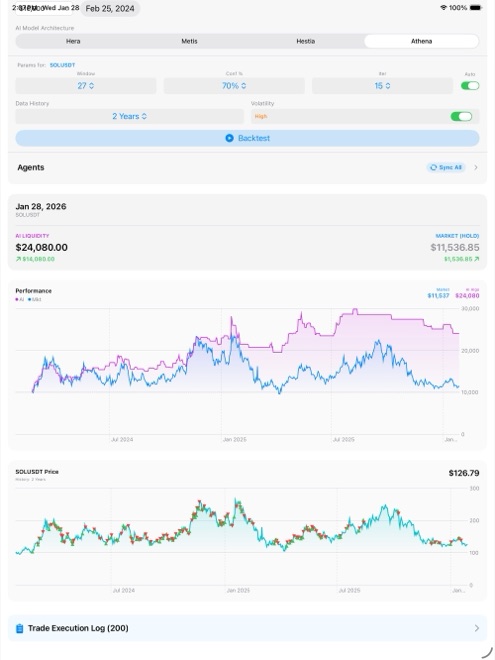
- Athena (Pro): factorial HMM tracking multiple hidden regime layers simultaneously.
Hestia: modelling how long a crypto regime tends to last
In a standard Markov chain, the implied dwell time inside any state follows a geometric distribution—meaning the highest single-bar exit probability occurs immediately after entering the state. On noisy hourly or daily crypto bars, that geometric memorylessness can cause rapid state chatter during choppy weeks.
Hestia (Plus) introduces duration awareness (akin to hidden semi-Markov structure), explicitly modelling how many bars a trend or consolidation typically persists before switching. When historical trends on a pair tend to run for multi-week stretches, Hestia penalises premature flip-flopping caused by a single counter-trend candle.
Athena: separating layered regimes with a factorial HMM
Markets rarely have just one hidden dimension: directional trend (up vs down) and volatility environment (calm compression vs violent expansion) can shift on independent clocks. A calm grind higher behaves very differently from a parabolic blow-off top, even though both print positive average drift (mu).
Athena (Pro) implements a factorial hidden Markov model that decomposes latent market state across parallel chains—allowing directional posture and volatility layering to evolve together without exploding a single transition matrix into dozens of sparse states.
Test model complexity systematically without fooling yourself
More parameters do not automatically produce a better simulation; on short five-minute histories, a complex model can memorise noise that a three-state baseline ignores. Compare the four architectures using controlled one-variable steps.
Keep every other setting fixed while rotating models on the same Binance USDT asset.
- Fix your asset, bar interval, start date, window length, and iteration budget, then run Hera first to record the baseline equity curve and regime switches.
- Switch to Hestia without enabling extra signals to isolate whether explicit regime duration reduces whipsaw trades during sideways ranges.
- Sync your chosen context agents and test Metis to observe whether external macro or sentiment inputs shift transition timing meaningfully.
- Evaluate Athena on longer daily or multi-month histories where layered volatility and trend states have enough bars to estimate cleanly.
Does Athena always beat Hera in historical backtests?
No. Factorial models capture richer multi-layer dynamics when given sufficient data history, whereas simpler models like Hera can be more stable on shorter windows or thinly traded pairs. Testing that trade-off is why all four sit side by side.
What should I adjust if a model fails to converge?
Increase the iteration budget or widen the historical training window so each hidden state observes enough return bars, or try auto-tune to pick stable window and confidence values.
Which subscription tiers include Hera, Metis, Hestia, and Athena?
Hera is free with no time limit. Plus ($7.99/month with a one-week free trial, or $79.99/year) unlocks Metis and Hestia; Pro ($12.99/month with a three-day free trial, or $129.99/year) unlocks Athena alongside advanced agents, guards, and the execution log.