Backtest Crypto Regime Models Without Look-Ahead
Many flashy crypto backtests look unbeatable on paper only because they accidentally use Friday’s closing price to enter a trade on Friday morning. Market Brief AI replays simulated BUY, SELL, and WAIT decisions using strict closed-bar semantics alongside a passive buy-and-hold benchmark so you can evaluate regime hypotheses honestly without risking capital.
How look-ahead bias ruins naive regime simulations
Look-ahead bias creeps into quantitative notebooks in two classic ways: computing a bar’s regime label using the bar’s own high-to-close return and filling a simulated BUY at that bar’s opening price, or smoothing state probabilities across the entire multi-year dataset (full-sample smoothing) before replaying historical trades.
When future volatility leaks backward by even a single candle, the simulated strategy magically sidesteps sudden red candles before they happen. Honest research requires evaluating signals strictly on closed-bar information—using only data settled at the close of bar t to decide the posture carried forward, matching the exact information boundary a real-time observer faces.
- Closed-bar semantics: signals evaluate only completed candle data rather than peeking inside an unfinished bar.
- Explicit posture states: every step resolves to BUY, SELL, or WAIT under identical live and historical logic.
- Transparent trade markers: chart pins show precisely where posture changed so suspicious timing jumps stand out visually.
Why buy-and-hold is the mandatory crypto baseline
During strong multi-year crypto bull cycles, an erratic strategy that randomly sits in cash half the time can still end with a positive dollar return—creating the illusion of model skill when passive holding gained twice as much with zero turnover. Conversely, during deep bear drawdowns, preserving simulated capital in WAIT posture matters far more than chasing every minor bounce.
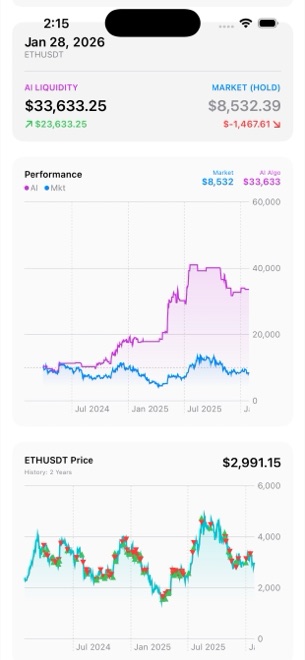
Market Brief AI draws the simulated strategy equity curve in purple directly over the passive buy-and-hold curve in blue for your chosen starting capital ($100 up to $1B) and start date, displaying the final figures side by side with the net difference highlighted.
Run a disciplined multi-window simulation test
Testing a regime setup on only one favourable bull run tells you almost nothing about robustness. Slice historical Binance USDT data across contrasting market eras to see where the rule earns its keep and where it lags.
Use this four-step routine whenever you evaluate a model or signal change.
- Pick a liquid Binance USDT pair with deep history (such as BTCUSDT or ETHUSDT daily bars back to 2017) and set a realistic starting test capital.
- Run a baseline Hera simulation from a cycle peak (for example, late 2021) to observe behaviour across a prolonged drawdown and recovery.
- Re-run the exact same parameters starting from a depressed accumulation range or sideways chop year without touching confidence or window sliders.
- Compare the purple strategy curve against the blue buy-and-hold curve across all three start dates, checking whether outperformance came from dozens of consistent switches or one lucky exit.
Remember friction and simulation limits
Even a bias-free closed-bar simulation remains a mathematical abstraction of public spot prices. Real-world markets involve bid-ask spreads, exchange fees, funding or slippage during fast cascades, and emotional hesitation—none of which turn a historical chart into guaranteed future returns.
Market Brief AI has no brokerage link and executes no real orders. Use the backtester to falsify weak ideas cheaply on your iPhone or iPad rather than treating historical equity curves as investment predictions.
What does closed-bar execution mean in Market Brief AI?
It means the backtester makes BUY, SELL, and WAIT decisions only after a price bar has closed, following the exact same rule sequence a live reading uses so intra-bar hindsight cannot inflate results.
What starting capital and timeframes can I simulate?
You can simulate any starting capital from $100 to $1B from any available historical date across daily bars (back to 2017 on long-listed Binance USDT pairs) as well as recent hourly and five-minute bars.
Does beating buy-and-hold in a backtest mean a strategy will profit live?
No. Historical backtests describe past price series under simplified assumptions and never predict or guarantee future returns. Market Brief AI provides simulations strictly for educational research.