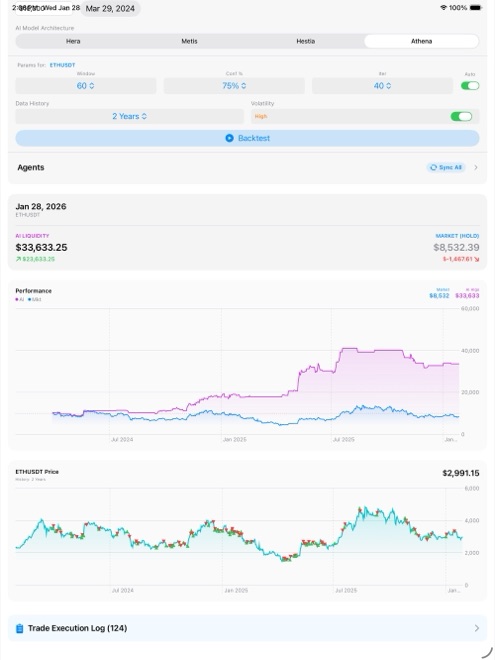
Crypto Backtest Risk Guards: CUSUM and Crash Stops
Statistical regime models intentionally balance responsiveness against noise—which means during a sudden 25 percent crypto liquidation cascade, waiting three bars for regime confirmation can deepen a simulated drawdown sharply. Market Brief AI Pro places four explicit risk guards—flash-crash detection, EMA crash guard, CUSUM drift guard, and hard stop—above the signal layer so you can test defensive circuit breakers rigorously.
Why Markov transition smoothing lags sudden tail events
When an asset has spent forty consecutive days in a low-volatility uptrend, its posterior bull probability sits near 0.95. If an abrupt weekend shock drops price 12 percent in a single candle, Bayes’ rule updates bear likelihood upward—yet high regime persistence can still demand a second confirming bar before switching posture on its own.
Risk guards separate normal regime inference from defensive capital-preservation rules. Instead of warping your HMM’s confidence parameter to react hyper-nervously on every ordinary Tuesday, you let the regime model read normal structure while dedicated guards watch for structural breaks.
How each of the four Pro risk guards operates
Each guard targets a different failure velocity—from violent single-bar vertical drops to slow, grinding structural decay.
Understand what kind of market pathology each guard is built to catch.
- Flash-crash detector: watches for extreme single-bar or rapid multi-bar downward price shocks that exceed normal volatility bounds.
- EMA crash guard: checks price breakdown relative to an exponential moving average trend floor to step aside during sustained structural collapses.
- CUSUM drift guard: applies cumulative sum (CUSUM) sequential change-point detection, accumulating persistent negative return deviations until their running sum crosses a drift threshold—catching "death by a thousand small red bars."
- Hard stop: enforces a strict maximum percentage loss ceiling per simulated position regardless of model probability.
Measure the V-rebound cost of tight defensive stops
Every risk guard carries an unavoidable symmetrical cost: cash out during a panic wick that immediately snaps back in a V-shaped recovery, and your simulated equity curve locks in the dip while passive buy-and-hold rides the rebound untouched. Honest testing evaluates both maximum drawdown saved and upside forfeited.
Test guards one at a time across crypto’s sharpest historical stress windows.
- Run an unguarded Hera or Hestia backtest across a history window containing both sudden liquidation wicks and prolonged multi-month bear trends (such as 2021–2023 daily BTCUSDT or SOLUSDT).
- Toggle on the CUSUM drift guard alone and check the execution log to see where cumulative negative drift exited slow bleed-outs earlier than the base HMM.
- Test the EMA crash guard and flash-crash detector individually, watching chart markers around sharp V-bottoms to spot premature shakeouts.
- Add a hard stop last and verify whether tighter stops reduced peak-to-trough drawdown or eroded cumulative simulated equity through repeated small stop-outs.
Simulated stops are not guaranteed live execution prices
In a closed-bar historical simulation, a guard triggers cleanly at the bar’s recorded close. In real live crypto markets during extreme cascades, order books thin out and actual stop orders can slip significantly past a trigger price.
Remember that Market Brief AI never connects to exchanges or manages real funds; treat guard experiments as quantitative stress tests of rule interactions rather than promises of downside protection.
What is a CUSUM drift guard in plain language?
CUSUM stands for cumulative sum control chart. Instead of waiting for one giant crash candle, it adds up consecutive smaller-than-expected negative returns over time and fires when the accumulated downward drift signals that the underlying return process has deteriorated.
How can I tell which risk guard closed a simulated trade?
In Market Brief AI Pro, open the trade execution log: every simulated SELL lists the exact rule or guard that fired it alongside the bar date and price.
Do risk guards eliminate trading risk in real markets?
No. Market Brief AI only simulates historical data on your device; in real trading, slippage, gaps, and whipsaws can cause substantial losses even when systematic stop rules are used.