Hidden Markov Models vs moving average crossovers in crypto: probabilities vs fixed lag
Simple and exponential moving average crossovers (such as the 50/200 golden cross or 9/21 EMA cross) react with deterministic lag based solely on price arithmetic, bleeding heavily during sideways crypto chop. Hidden Markov Models—like Hera, Metis, Hestia, and Athena in Market Brief AI—estimate bar-by-bar bull, chop, and bear probabilities from both return drift and volatility dispersion so you can test regime rules against buy-and-hold on iPhone and iPad for educational research, not financial advice.
1. Why fixed-window SMA/EMA crossovers whipsaw in crypto volatility
A moving average crossover looks only at smoothed price levels (first-moment drift) while ignoring variance (second-moment dispersion). When Bitcoin or an altcoin consolidates in a noisy 15% sideways band for four months, fast and slow EMAs braid back and forth repeatedly—generating binary buy-high, sell-low whipsaws with 100% apparent conviction on a 0.01% line cross.
A 3-state Hidden Markov Model such as Hera models both return mean (mu) and standard deviation (sigma) across three latent states: calm uptrend, noisy chop, and volatile decline. Instead of an all-or-nothing crossover, every bar receives a continuous probability distribution—letting a neutral WAIT posture absorb low-conviction chop.
| Property | Hidden Markov Models (Market Brief AI) | SMA / EMA Moving Average Crossovers |
|---|---|---|
| Information modelled | Return drift (mu), return volatility (sigma) & state transition matrix | Weighted average of closing prices only (ignores volatility shifts) |
| Handling sideways chop | Dedicated chop/transitional state + adjustable confidence threshold -> WAIT | Lines cross repeatedly inside flat ranges, forcing binary long/flat flips |
| Output representation | Continuous probability per bar (0%–100% across hidden states) | Binary boolean (fast MA above or below slow MA) |
| Regime duration awareness | Hestia (Plus) explicitly models expected state persistence | Memory limited strictly to fixed N-bar lookback arithmetic |
| External context integration | Metis (Plus) & Athena (Pro) incorporate macro/sentiment inputs | Purely univariate price arithmetic |
2. Combining probabilistic regimes with EMA crash guards
Moving averages are not useless—exponential averages excel as fast emergency tripwires rather than standalone regime classifiers. That is why Market Brief AI Pro includes an EMA crash guard alongside CUSUM drift, flash-crash, and hard-stop guards layered on top of HMM state probabilities.
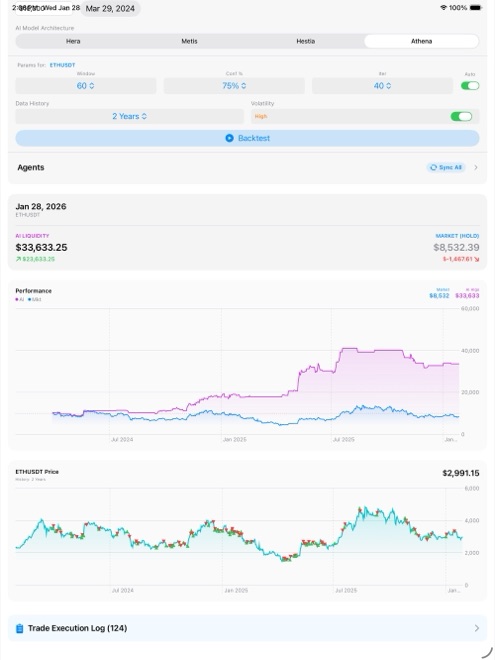
In Market Brief AI’s closed-bar backtester on iOS 26 and iPadOS 26, you can test pure Hera 3-state probabilities for free, or toggle Pro trend/auction signals and EMA crash guards to observe on the purple-vs-blue equity chart when hybrid rules beat or trailed passive buy-and-hold.
| Market environment | Typical SMA/EMA crossover flaw | How HMM + Market Brief AI tests handle it |
|---|---|---|
| Sudden volatility expansion at cycle top | 200-day SMA lags by weeks while 35% of gains evaporate | High negative-return variance shifts bear-state likelihood rapidly (+ Pro crash guards) |
| Multi-month horizontal consolidation | Repeated false golden/death crosses erode simulated equity | 3-state Hera & confidence filter keep strategy in neutral WAIT posture |
| Steady low-volatility grind higher | Captures trend smoothly once lag clears | High bull-state persistence keeps simulated posture aligned |
| V-shaped macro CPI / Fed shock | Slow MAs flip bearish right at the bottom before rebound | Kronos (CPI) & Demeter (Fed) agents + Metis/Athena add macro context |
| Verification against passive holding | Often eyeballed on charts without fee/churn awareness | Closed-bar replay plots purple equity directly over blue buy-and-hold |
3. Testing HMMs vs trend overlays on your own iPhone or iPad
Neither moving averages nor Hidden Markov Models predict tomorrow’s news or guarantee profits—during sharp V-reversals, every historical estimator faces trade-offs between reactivity and whipsaw noise.
Market Brief AI gives students of markets an ad-free, zero-account laboratory ($0 Free, $7.99/mo Plus, $12.99/mo Pro) to see that trade-off directly on any Binance USDT pair back to 2017.
| Experiment to run | Market Brief AI tier | What to inspect |
|---|---|---|
| Baseline 3-state Hera HMM vs passive buy-and-hold | Free ($0) | Adjust confidence slider on BTCUSDT daily bars across 2021–2025 |
| Duration-aware Hestia vs standard Hera turnover | Plus ($7.99/mo) | Compare how state-duration modeling alters short chop switches |
| Athena factorial HMM + SuperTrend + EMA crash guard | Pro ($12.99/mo) | Read the full trade execution log to see which rule fired each exit |
Does an HMM always beat a 50/200 moving average crossover?
No model beats every simple rule on every window. Market Brief AI’s closed-bar backtester exists specifically so you can test different assets and start dates honestly against buy-and-hold.
Why does volatility matter so much in crypto regime detection?
Crypto bull advances often exhibit steadier upward drift, whereas bear cascades feature violent variance spikes; HMMs use both mean and variance to separate states faster than price averages alone.
Can I still use trend indicators alongside HMMs in Market Brief AI?
Yes. Market Brief AI Pro includes SuperTrend, fractal pivots, flag patterns, five auction signals, and an EMA crash guard layered atop the regime model.
Is comparing HMMs and moving averages financial advice?
No. All explanations and Market Brief AI simulations are strictly educational and informational, never investment recommendations.