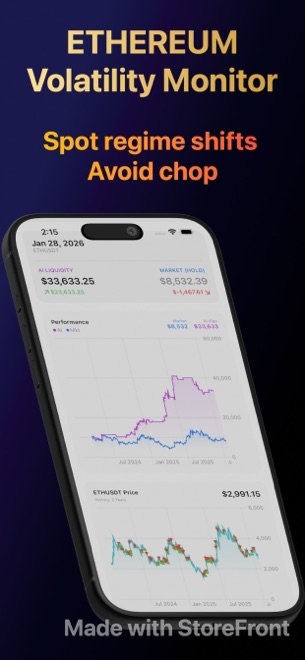
Market Brief AI vs Python hmmlearn notebooks: instant iOS HMMs vs custom Jupyter pipelines
Python libraries such as hmmlearn, statsmodels, and PyTorch give desktop coders unlimited freedom to invent custom emission distributions and research papers from scratch. Market Brief AI eliminates data-pipeline maintenance when you want to test crypto regimes on iPhone or iPad in under a minute—shipping four pre-engineered Hidden Markov Models (Hera, Metis, Hestia, Athena), Core ML FinBERT, eight macro/calendar agents, and closed-bar backtesting strictly for educational simulation, not financial advice.
1. Four pre-built HMM architectures vs coding beyond basic GaussianHMM
In Python, fitting a textbook 3-state GaussianHMM with hmmlearn takes twenty lines of code, yet moving beyond baseline returns requires substantial engineering: writing pagination scripts for Binance candles, aligning BLS CPI release dates without timestamp leakage, downloading Hugging Face FinBERT weights, and coding custom duration-aware (HSMM) or factorial HMM inference from scratch.
Market Brief AI ships all four architectures natively on iOS 26 and iPadOS 26: Hera (classic 3-state HMM, Free), Metis (input-aware HMM, Plus), Hestia (duration-aware HMM, Plus), and Athena (factorial multi-layer HMM, Pro), alongside Core ML FinBERT and named public-data macro agents.
| Component | Market Brief AI (iPhone & iPad) | DIY Python (hmmlearn / Jupyter) |
|---|---|---|
| Baseline 3-state HMM | Hera built in Free (window, confidence, iterations & auto-tune) | hmmlearn.hmm.GaussianHMM (requires manual state sorting) |
| Input-, duration- & factorial HMMs | Metis (input), Hestia (duration) & Athena (factorial) ready to toggle | Requires custom PyTorch/Stan/pomegranate code beyond basic hmmlearn |
| Public data ingestion | One-tap sync: Binance USDT, GDELT, BLS CPI, Fed, S&P 500, USGS, NOAA | Write & maintain separate REST scrapers, rate limits & pandas joins |
| FinBERT sentiment scoring | Bundled Core ML FinBERT running on Apple silicon out of the box | Install transformers/PyTorch & manage multi-hundred-MB model weights |
| Custom arbitrary math equations | Fixed menu of 4 HMMs, signals & guards | Unlimited custom equations, covariates & export formats |
2. Avoiding full-sample smoothing & look-ahead traps in backtests
The single most common mistake in beginner hmmlearn notebooks is calling model.predict_proba(X) across ten years of returns at once—which runs forward-backward smoothing using future bars—and then backtesting trades on those smoothed probabilities, producing wildly unrealistic equity curves.
Market Brief AI enforces closed-bar semantics automatically when replaying BUY, SELL, and WAIT decisions against passive buy-and-hold ($100 to $1B virtual test capital), and in Pro logs the exact rule behind every simulated trade.
| Dimension | Market Brief AI | Custom Jupyter Pipeline |
|---|---|---|
| Closed-bar execution boundary | Enforced natively across simulated historical replays | Researcher must manually prevent forward-backward smoothing leaks |
| Signals & risk guards | Toggle SuperTrend, pivots, 5 auction signals & 4 crash/drift guards (Pro) | Hand-code and unit-test each stop/CUSUM filter in Python |
| Mobile & couch usability | Native touch UI on iPhone & iPad; works offline once synced | Requires laptop, Python virtualenv, or cloud Colab runtime |
| Privacy & credentials | 100% local on device; zero accounts or API keys | 100% local if run on your own laptop |
| Advisory boundary | Educational simulation tool; never financial advice | Self-authored research code |
3. Rapid mobile triage before deep desktop coding
Quantitative developers do not need to abandon Python to appreciate Market Brief AI. Using the iPad app as a fast triage lab lets you check in sixty seconds whether an asset’s Binance USDT history even exhibits persistent Markov regimes—saving hours of pointless notebook plumbing.
And for students or investors who do not write Python at all, Market Brief AI opens genuine HMM experimentation for $0 Free, $7.99/mo Plus, or $12.99/mo Pro.
| Scenario | Best choice | Why |
|---|---|---|
| Writing a custom academic paper with bespoke covariance tensors or CSV exports | Python + Jupyter | Full programmatic flexibility over raw matrices |
| Testing 3-state, input, duration & factorial HMMs in 60 seconds on iPad | Market Brief AI | Zero broken pip dependencies or scraper maintenance |
| Checking regime + CPI/Fed/FinBERT combinations during a commute offline | Market Brief AI | Synced data and trained models live right in your pocket |
| Learning HMM regime concepts without coding experience | Market Brief AI Free | $0, no account, interactive parameters, and buy-and-hold comparison |
Why do so many DIY Python HMM crypto backtests look unrealistically smooth?
Calling full-sample predict_proba() smooths today’s state probability using tomorrow’s crashes. Market Brief AI replays simulated trades using closed-bar rules so future candles do not leak backward.
What hyperparameters can I tune in Market Brief AI?
You control the lookback window, confidence threshold, and iteration budget for the selected HMM—or let auto-tune pick—plus starting capital, start date, and Pro strategy blend.
Can Market Brief AI export raw Python code or CSV tables?
No. Market Brief AI is a self-contained iPhone and iPad visual simulation app storing models, forecast cards, and execution logs inside its local database.
Are Market Brief AI simulations suitable for live automated trading?
No. Market Brief AI is strictly an educational analysis and strategy-simulation tool; nothing it shows is financial advice or guarantees real-world results.