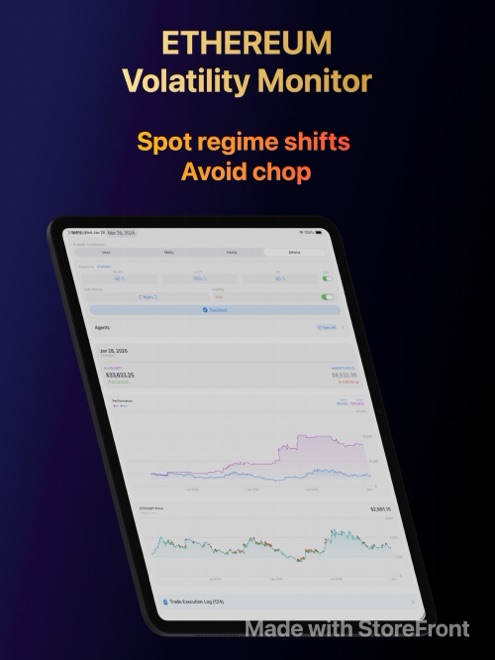
Market Brief AI vs Glassnode: mobile on-device HMM backtests vs on-chain UTXO cohorts
Glassnode is built for institutional and on-chain analysts studying blockchain ledger internals such as Bitcoin UTXO age bands, MVRV, realized cap, and exchange netflows on desktop web dashboards. Market Brief AI gives iPhone and iPad users an accessible ($0 to $12.99/month), zero-account statistical lab that fits four Hidden Markov Models to any Binance USDT spot pair and backtests simulated regime strategies against buy-and-hold—strictly for educational analysis, not financial advice.
1. Statistical return-regime modeling vs blockchain ledger indexing
Glassnode indexes raw Layer-1 blockchains to measure holder cost basis (SOPR, NUPL, MVRV) and coin dormancy, primarily deepest on Bitcoin and Ethereum. However, many actively traded altcoins quoted in USDT lack deep UTXO cohort histories, and reading a weekly on-chain chart still leaves bar-by-bar volatility regime transitions unmodelled.
Market Brief AI works directly from price-return series available for any Binance USDT spot pair—daily candles back to 2017 plus recent hourly and five-minute intervals—and enriches those returns with public macro agents (BLS CPI, Fed tone, S&P 500), seasonal cycles, and on-device Core ML FinBERT news sentiment.
| Dimension | Market Brief AI | Glassnode Studio |
|---|---|---|
| Core methodology | On-device Hidden Markov Models (Hera, Metis, Hestia, Athena) + signal/guard layers | Cloud-indexed blockchain UTXO, address cohort, miner & exchange flow metrics |
| Pair coverage breadth | Any Binance USDT spot pair sorted by volume | Deepest on BTC & ETH; varying metric depth across supported chains/tokens |
| Intraday & daily granularity | Daily (from 2017), hourly, and 5-minute spot bars | Block/daily resolution on lower tiers; finer resolution on high-end plans |
| Macro & news integration | Kronos (CPI), Zeus (S&P 500), Demeter (Fed), GDELT FinBERT sentiment | Selected macro liquidity charts inside Studio dashboards |
| Native platform focus | Native iOS 26 & iPadOS 26 app computing locally on Apple silicon | Desktop-first web terminal & API platform |
2. Closed-bar backtesting vs workbench formula charting
In Glassnode, testing whether an indicator threshold outperformed holding typically requires upgrading to paid Workbench tiers or exporting CSVs through APIs into Python. Market Brief AI puts closed-bar backtesting on the primary screen for every user, including the free tier.
You pick a starting capital ($100 to $1B) and start date, fit your chosen HMM with custom or auto-tuned window and confidence settings, and immediately inspect the purple simulated strategy curve over the blue buy-and-hold curve—with Pro unlocking the complete execution log of every simulated trade.
| Capability | Market Brief AI | Glassnode |
|---|---|---|
| One-tap closed-bar backtest | Included free on every Binance USDT pair against buy-and-hold | Requires custom Workbench formulas or external backtest scripts |
| Forecast & execution audit | Plus saves 10 forecast cards/asset; Pro logs every simulated trade reason | Chart Studio annotations and alert rules |
| Compute & AI privacy | 100% local HMM fitting & Core ML FinBERT; zero cloud AI or analytics SDKs | Cloud-hosted analytics platform requiring registered user account |
| Offline capability | Full offline access to synced prices, trained models, charts & logs | Online web application |
| Financial advice / trading | Educational simulation only; no live trading or financial advice | Analytical data provider; no trade execution |
3. Retail-accessible iOS pricing vs institutional data budgets
Glassnode’s institutional and professional tiers can run hundreds of dollars per month when unlocking high-resolution on-chain metrics and API quotas—pricing geared toward funds and full-time research desks rather than individual students of quantitative finance.
Market Brief AI keeps quantitative regime experimentation approachable: Free forever with Hera and no ads, Plus at $7.99/month ($79.99/year, 7-day free trial) for Metis and Hestia, and Pro at $12.99/month ($129.99/year, 3-day free trial) for Athena, all signals, risk guards, and full trade logs.
| User profile or budget | Best-fit option | Why |
|---|---|---|
| Fund desk tracking Bitcoin long-term holder UTXO supply & miner reserves | Glassnode | Purpose-built raw blockchain ledger cohort indexing |
| Individual researcher fitting HMMs across BTC, ETH, SOL & altcoin USDT pairs | Market Brief AI | Works uniformly on any Binance USDT spot pair on iPhone and iPad |
| Under $15/month budget for advanced multi-regime & risk-guard simulation | Market Brief AI Pro | $12.99/month ($129.99/year) unlocks Athena, Zeus, Demeter & full logs |
| Zero-cost, zero-login introduction to Hidden Markov Models | Market Brief AI Free | Hera 3-state HMM and closed-bar backtester with no account or ads |
| Private offline experimentation during flights or commutes | Market Brief AI | Trained models and synced datasets live locally in the device database |
Does Market Brief AI track on-chain wallet balances or exchange inflows like Glassnode?
No. Market Brief AI models statistical price regimes from public Binance USDT spot bars combined with public macro, calendar, environmental, and GDELT news feeds—not blockchain UTXO ledgers.
How much does Market Brief AI cost compared with institutional crypto suites?
Market Brief AI has a permanent Free tier, Plus at $7.99/month ($79.99/year with a 1-week trial), and Pro at $12.99/month ($129.99/year with a 3-day trial) via Apple In-App Purchase.
Does Market Brief AI require creating an account or sharing my email?
No. Market Brief AI has no user accounts, collects no personal data, includes no analytics SDKs, and handles subscriptions solely through Apple.
Is Market Brief AI output a buy or sell recommendation?
No. All regimes, probabilities, signals, and backtests are strictly informational and educational simulations, never financial advice.